

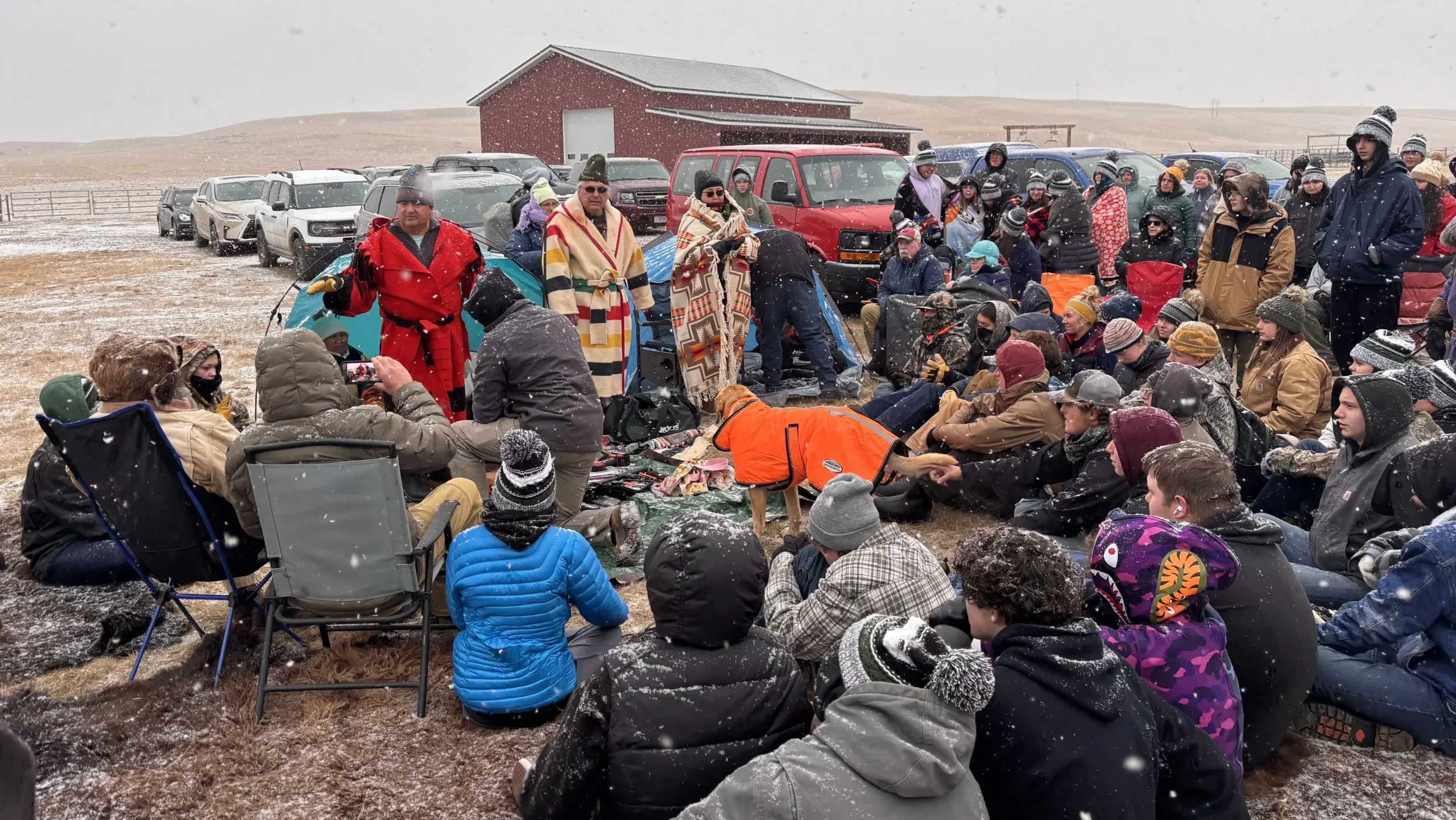
Last month, about 40 Helena high school students loaded onto a school bus at 6:30 a.m. and departed to the Big Sky Bison Ranch in Cascade County.
With snow falling later that day, the students gathered around Blackfeet elders to watch, learn and, for some, reconnect to their cultural history through the harvest of a bison — a classroom first for Helena’s students.
The district’s Indian Education academic specialists Terri Johnson and Joe Pichardo spearheaded the harvest project, which they began planning last year. Johnson told Montana Free Press the harvest was a unique learning opportunity for everyone who participated.
“It was a completely different way of viewing education,” Johnson said. “I think it just showed how education can leave the classroom.”
Helena students and teachers were able to join a Great Falls student group on the ranch for the harvest, something that the Great Falls district has been doing for several years.
The Helena group included students from culinary and environmental science classes, as well as several Native American students from both Helena and Captial high schools.
“It was a completely different way of viewing education. I think it just showed how education can leave the classroom.”
Terri Johnson, Indian Education academic specialist
Students had the opportunity to watch or participate in harvesting the bison’s organs while learning how the animal was traditionally used in Blackfeet and other Native cultures.
Pichardo, who also teaches traditional Native games and history throughout the Helena school district, told MTFP that the chance for students to interact with Native culture in an immersive, hands-on approach was significant.
“They can tell their family, their friends, ‘This is what was done on this land by the Blackfeet. This is what was done on this land by the Gros Ventre, by the Salish,’” Pichardo said.
Some of Helena’s culinary students cooked the meat from the bison on site, dividing pieces to share.
“I remember it tasting exquisite.” Helena High junior Hazel Bishop told MTFP. “It was like an interesting flavor. Tasted mostly like meat, but almost had like a unique taste to it that I really enjoyed.”
Bishop, who is also an AP environmental science student, said that she and her fellow classmates learned a lot from the harvest itself.
“It was shot underneath the ear right through, so it was killed immediately with one bullet. That’s super humane,” Bishop said. “Then they bring it back and they gut it. And then they harvest it, and everything’s used. I don’t think any of it was thrown away at all.”
While most of the bison meat was saved for processing and later distribution for Helena families and food pantries, the heart, eyes and several other organs were brought back to Helena High to be used in science classes.
Johnson said the bison’s head will be buried and cleaned using beetles. Then, the skull will be painted and displayed to commemorate the event. The bones will be cleaned and used for traditional games and art, and the hide will be divided and shared throughout the district’s elementary school libraries.
The harvest was a first for the Helena school district and for most of the students, and some described being deeply impacted by the experience.
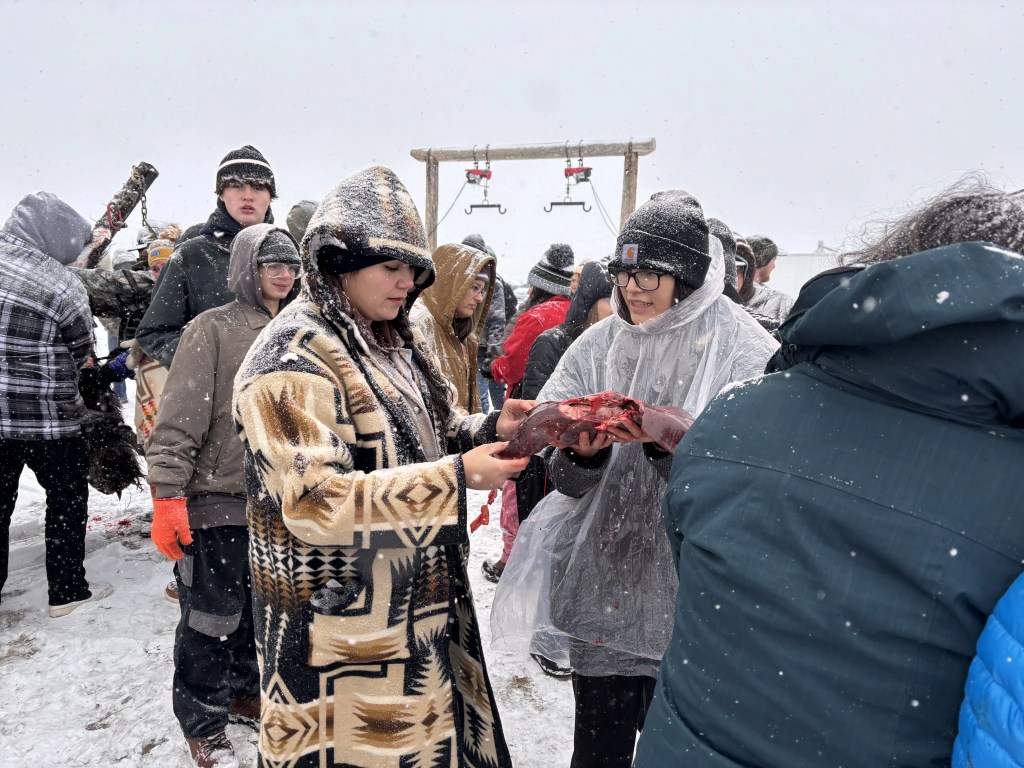
“For me, participating was a big deal for me because my family, over time, we lost our culture,” said Kadence Gallegos, who’s Blackfeet and a sophomore at Capital High. “So I want to get that back and being able to get that close and learn about how Native tribes did and use all this. It connected me a lot.”
Kathleen Pitkanen, Northern Arapaho and a sophomore at Capital High, expressed her excitement about being a part of something significant to her Native heritage.
“I was just like super excited and happy. It was just like another way for me to connect with my heritage and my ancestry,” Pitkanen said. “Because I grew up more urban than some other people I know, I never really learned anything about my culture until I came to high school.”
Larry Ground and Dugan Coburn were among the Blackfeet elders who facilitated a pipe ceremony that kicked off the harvest. In addition, a naming ceremony was conducted, and five of Helena’s Native students, including Gallegos and Pitkanen, were given names.
According to Ground, in Blackfeet tradition, those with naming rights — either mothers, community leaders or military veterans — can name individuals. Ground, who’s also a veteran, said that, in a spiritual sense, these tribal names help those understand who they are and push them into a new start in their lives.
“My students, and especially those of us who are considered urban Natives, we don’t have a lot of opportunities to attend naming ceremonies or just ceremony in general,” said Pichardo, who is Blackfeet and Chippewa Cree. “So for them to be able to do that, and kind of experience what that was like, it was amazing, and to me, that’s something they’re going to carry with them for the rest of their lives.”
From learning about the history of the bison to understanding the animals’s cultural significance, the day wouldn’t have happened without the support of the schools and members of the community, Johnson said.
The Helena Education Foundation helped pay the ranch for the bison, and the Helena Indian Alliance donated beanie hats and provided meals to the students. The Old Salt Co-op waived the processing fees for the bison meat, and the 1889 Coffee House donated coffee.
Helena High School and the education foundation helped cover the cost of substitute teachers attending the field trip.
While the harvest sparked interest among both students and teachers who participated, the district has not yet confirmed whether it will be an annual event, mostly because of the cost.
Interested individuals or businesses can send donations to either the Helena High School Native Leadership Council, 1300 Billings Ave., or Capital High School All Nations Youth Leadership Council, 100 Valley Dr., to help support a future harvest.
“I mean the support from the community, the more that they know how powerful it is, maybe that’s where we can get the financial support to do it. I want my students out there experiencing it also,” said Helena High world studies teacher Lauren Gustafson, who participated in the harvest.
“Just to provide that connection with culture, it just makes what I’m teaching so much more powerful and really resonates with the students.”
In-depth, independent reporting on the stories impacting your community from reporters who know your town.
LATEST STORIES
Federal judge blocks Montana’s AI campaign ad law
A Montana law regulating the use of generative artificial intelligence in campaign ads has been dealt a blow by a federal judge based on freedom of speech concerns. The order greenlights general election advertising that former legislator Dan Bartel and ASG PAC planned to use, but feared being prosecuted for.
Montanans are using AI, but remain wary of its societal impact
Almost four years after OpenAI’s release of ChatGPT, AI is now firmly rooted in many Montanans’ day-to-day tasks, according to a Montana Free Press-Eagleton poll of registered voters conducted in late August and early September. More Montanans use AI — and to some extent trust AI — for general searches, work tasks and writing, than for more intimate functions, like medical advice or companionship. Users remain skeptical of the technology’s broader impacts, too. Only about 12% believe AI has a “somewhat” or “very positive” impact on society.
Broadview area data center sees first phase of construction with roads, well work
Quantica has agreed to use local, unionized labor when possible, under a memorandum of understanding it signed with the Southeastern Montana Building and Construction Trades Council. Riley McCauley, vice president of the council, said they won’t have details on job numbers or wages until Quantica has secured an “end user,” or a digital or AI company, to purchase the facility.
